The Intelligence Estate
An Intelligence Estate is one place where the important parts of your work and life accumulate over time, in a form that can actually be used — files you own, connected to each other, readable by both you and any AI system you point at them. Most knowledge doesn't disappear because nobody wrote it down. It disappears because it was written down in forty different places, and none of them talk to each other.
I've spent an embarrassing amount of time over the last couple of years trying different ways to organize information. OneNote. Task managers. Random notebooks. Folders. Bookmarks. Screenshots I would absolutely never look at again. Notes inside AI tools. Notes about the notes inside AI tools.
You get the idea.
The problem was never that I didn't have the information. The problem was that it was everywhere.
Once I started using AI more heavily for work, that problem became much more obvious. I could have an incredibly useful conversation about a customer, a product idea, a strategy, a house project, whatever — and three days later that conversation might as well have happened in another country.
The information existed. It just wasn't part of anything.
What an Intelligence Estate is
That's what eventually pushed me toward building what I started calling an Intelligence Estate.
Not a "second brain." That phrase always felt a little too self-help-book to me.
An Intelligence Estate is simply one place where the important parts of your work and life accumulate over time in a way that can actually be used.
For me, Obsidian became the foundation. Not because Obsidian is magic. It's just files. That's actually part of why I like it.
My information isn't trapped inside somebody else's application waiting for a pricing change, an acquisition, a shutdown, or an "exciting new redesign" that moves the button I use every day. It sits in normal markdown files.
And over time those files started becoming much more useful than notes. They became the memory of my business.
What actually goes in there?
Almost everything worth remembering.
- Customer notes, meeting notes, competitive research
- Product ideas and things I want to build six months from now
- Sales strategy and processes
- House projects, things I need to cancel, things I need to buy
- Stuff I learn, stuff I screw up, and stuff I don't want to screw up twice
I might write: "Call and cancel XYZ home service next Tuesday."
Or: "Build an omnichannel campaign around managed IT services targeting 50–500 employee companies in Indiana."
Those are obviously very different things. But both need to go somewhere.
Before this, they would have gone into two completely different systems. Maybe one becomes a task. Maybe the other becomes a document. Maybe I send myself a text. Maybe I write something on a legal pad. Maybe I tell an AI assistant about it and assume Future Josh will somehow remember where that conversation happened.
Future Josh, historically, has not been great at that.
So the Estate became the catch basin.
The important part isn't capture
There are a thousand tools that can capture information. The important part is what happens afterward.
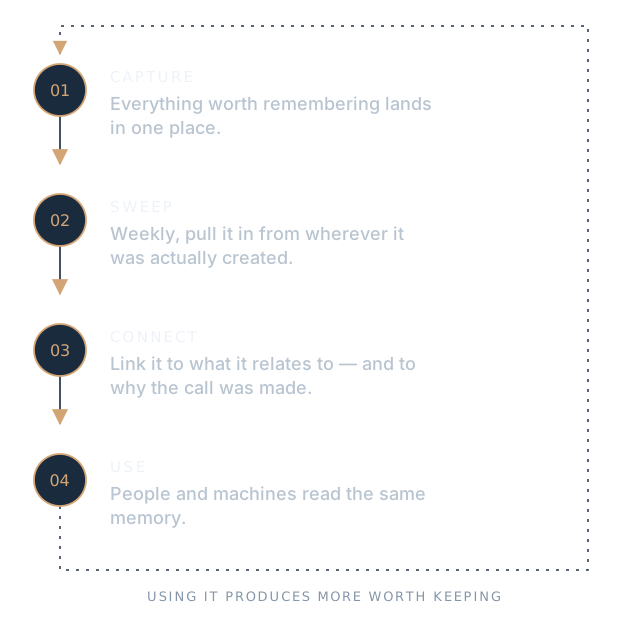
Every week, I sweep information into the Estate from the places where it naturally gets created. AI conversations. Handwritten notes. OneNote. Tasks. Calendar. Documents. Loose ideas.
The goal isn't to perfectly organize everything the second it appears. That sounds nice and lasts about four days.
The goal is to make sure useful information eventually finds its way home.
Once it does, it can be connected to the things around it. A customer connects to the meetings I've had with them. The meetings connect to the problems they've described. Those problems connect to ideas, products, competitors, people, and future actions. A project connects to the reason I started it. A decision connects to the information I had when I made it.
Recording what happened is easy. Recording why is not.
That last one is more important than it sounds.
Most companies are very good at recording what happened. They are much worse at remembering why it happened.
Six months later somebody looks at a decision and says: "Why the hell did we do this?"
And sometimes there was a perfectly good reason. It just died in a meeting, a Slack thread, an email, or somebody's head.
That's organizational amnesia. And AI does not magically fix it. In some ways AI makes it worse.
The same problem, one level up
This is the thing I spend my working life on, scaled to a company.
Growth in an established business is rarely missing. It's constrained, and the constraint is usually invisible, because nobody sees the whole company. Sales knows what sales knows. Operations knows what operations knows. The reasoning behind a pricing decision two years ago left with the person who made it. Everybody is working from a partial view and calling it the view.
That's a visibility problem, and it starts as a memory problem. A business that can't remember why can't diagnose itself. It re-argues settled decisions, re-learns the same lessons, and re-tries the approach that failed twice, because nothing recorded why it failed. Intelligence is one of the six places growth gets constrained →
An Intelligence Estate is the personal version of that fix. Same shape, smaller scale.
AI creates more information than humans ever did
This was the part I didn't fully appreciate at first.
AI massively increases the amount of useful thinking you can produce. That sounds great. It is great. But it creates a new problem.
You can generate more ideas, analysis, research, strategies, drafts, and decisions in a week than you used to generate in a month.
Where does all of that go?
If the answer is "inside forty-seven different chats," you don't really have a knowledge system. You have a digital attic. A very impressive attic. But still an attic.
That was when the Intelligence Estate idea really clicked for me. AI shouldn't be another place where knowledge disappears. It should be one of the primary sources feeding a larger memory.
Everyone is going to have access to AI. The difference will be what their AI has learned about them.
What changes when your AI has context
Once I had the Estate built, my relationship with AI changed.
Instead of each conversation starting from scratch, I could give systems access to the work that came before. Customer history. Company strategy. Previous research. Decisions. Projects. Preferences. Lessons learned.
The AI suddenly had something much more useful than a clever prompt. It had context. Real context. The kind that normally takes a new employee months to accumulate.
That creates a completely different experience. You stop asking:
"What should I do?"
And start asking:
"Given everything we already know, what should I do?"
Those are very different questions.
Then I hit the next problem
The Estate worked great for me. But I wanted other systems to use it too. Different AI tools. Agents. My outbound engine. Things I'm building. Things I haven't built yet.
And that exposed another weakness.
Most AI tools want you to repeatedly feed them the same information. Upload this. Paste that. Index this folder. Create another database. Pay to process the same documents again. Then do it all over again for the next tool.
That started to feel pretty stupid. I already had the information. I already had the relationships. I already had the structure. Why should every new AI system rebuild my memory from scratch?
I couldn't find anything that worked exactly the way I wanted. So I built one. That became RecallWeave. And inside RecallWeave is Atlas, which lets me see the Estate as an interactive map — companies, people, ideas, projects, decisions, documents, and how they relate to one another.
I'll write more about that separately. But RecallWeave actually came second. The important idea came first.
How to start one
If you want to try this, the order matters more than the tools.
- Pick a format you own. Plain files on your machine, not rows in somebody's database. The test is simple: if the application disappeared tomorrow, would you still have everything?
- Give everything one front door. Tasks, ideas, customer details, strategy — same inbox. Two front doors becomes four, and four becomes none.
- Sweep weekly, not constantly. Pull information in from wherever it was actually created. Trying to organize at the moment of capture is the habit that fails first.
- Connect each decision to its reason. This is the step everyone skips and the one that pays the most later.
You will not get this right in the first month. That's fine. The value isn't a tidy folder structure. It's that in two years you still have it.
What this is really about
Build the Estate. Own your information. Let it accumulate. Make it useful to both humans and machines.
Because I think we're heading toward a world where one of the biggest differences between people — and companies — won't be who has access to AI.
Everyone will.
The difference will be what their AI has learned about them. And whether that knowledge survives past the end of the conversation.