Capability is accelerating. Value is not automatic.
Most AI reporting blends vendor benchmarks, incomparable surveys, and forecasts into one confident number, then leaves you to guess which parts are real. This brief keeps those questions apart. Every major claim carries two labels: how good the evidence is, and how real the capability is today.
Most AI reports are confident, tidy, and wrong where it costs money.
You have read the other AI reports, and you know the pattern. A vendor benchmark becomes "the best model." A survey of large enterprises becomes "everyone is doing this." A forecast becomes a result. A pilot becomes a deployment. Occupational exposure becomes job loss. A demo becomes a capability. Each leap is small. Stacked together, they produce a picture of AI that is confident, tidy, and wrong in exactly the places a budget owner pays for.
This brief was built to hold those questions apart. It does not treat a vendor claim as independent proof, a forecast as a realized return, or a benchmark score as a business outcome. Where two studies disagree because they measured different things, it says so instead of averaging them into a clean number that is easier to quote than to trust.
That discipline is the point. The value of a research brief in 2026 is not how much it tells you. It is how well it tells you what to trust.
What actually changed, and what it means for an operator.
Adoption is nearly universal. Value is not. 88% of enterprises use AI in at least one function; 6% qualify as high performers. The distance between those two numbers is the whole opportunity — and almost none of it is about the model.
The model stopped being the strategy. The frontier is now multi-lab and the gaps are narrowing. When everyone can rent the same capability, advantage moves to the workflow, the context, and the governance around it — the parts you cannot buy off a pricing page.
An agent that works "most of the time" is a demo, not an operator. Independent evaluation puts today's best agents at roughly a 12-hour task horizon at 50% success, but only about 1.5 hours at 80%. The impressive number and the dependable number are an order of magnitude apart.
AI search is compressing the click. Users click a traditional result in 8% of searches with an AI summary, versus 15% without. Being cited inside the answer is starting to matter more than ranking below it.
Workflow redesign is the dividing line. Organizations that redesigned workflows reported meaningful value at roughly five times the rate of those that bolted AI onto existing steps. It is an association, not proof — but it is the strongest operating signal in the data.
The buildout is historic. The customer return is not proven yet. Stanford reports $285.9 billion of U.S. private AI investment in 2025; Gartner forecasts $2.59 trillion of global AI spending in 2026. Those numbers confirm demand and capacity. They say nothing about whether adopters are earning it back.
Adoption is easy. Everything after it falls off a cliff.
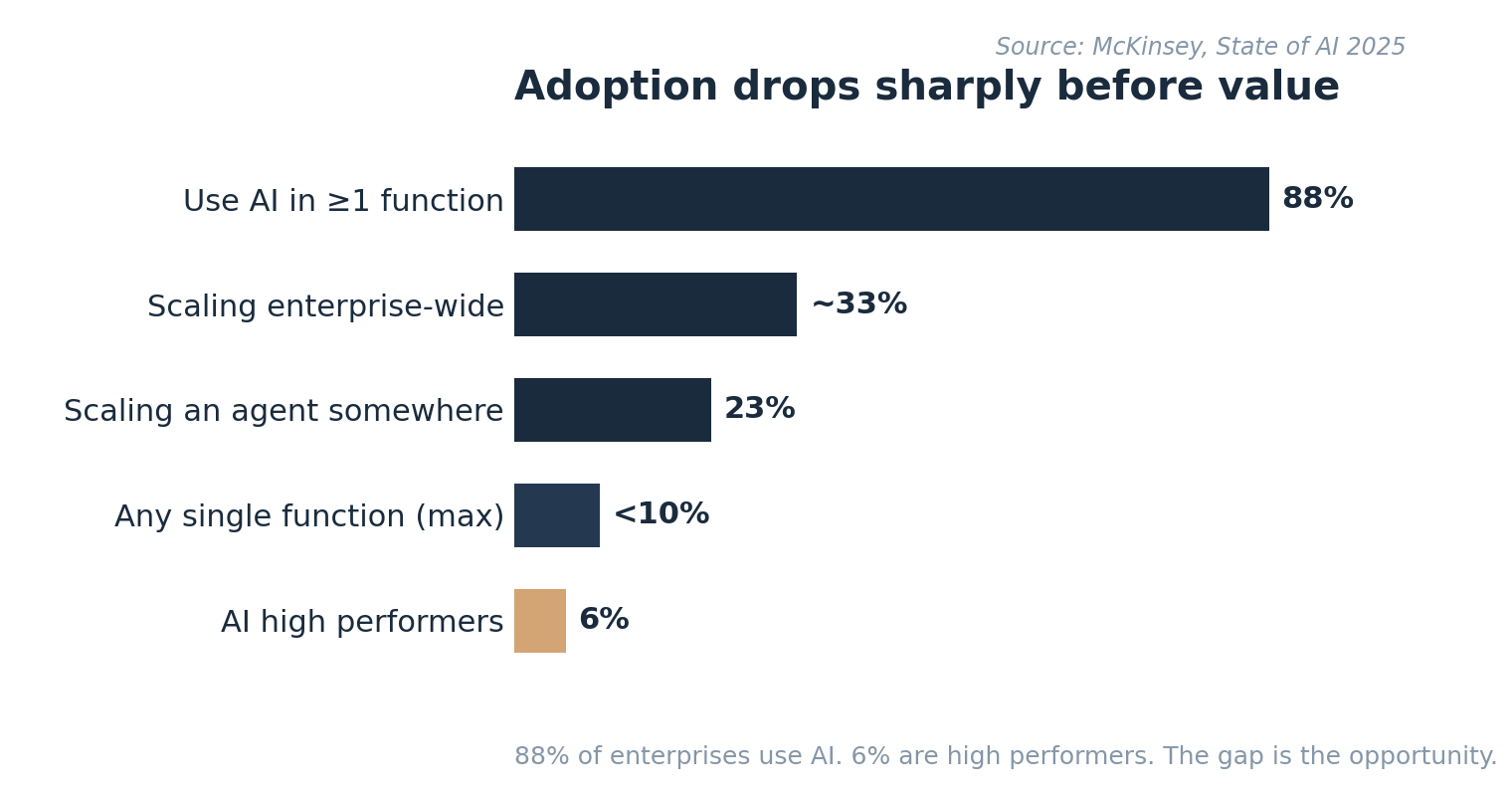
What separates the 6% from the 88% is rarely the model. It is whether the company underneath has a connected place for AI to work from — the architecture that sits underneath adoption →.
We graded the evidence.
Every claim carries an evidence status and a reality status. A confirmed government statistic and a vendor's press-release number do not get to wear the same clothes.
Confirmed · Reported · Estimate · Inference · Unknown — how good the support behind a claim actually is.
Real Now · Scaling · Early · Overhyped · Watch — how usable the capability is today, not in a keynote.
You do not have to study the system to benefit from it. But when the brief calls agents "Scaling" and mass job replacement "Overhyped," you know exactly how much weight that judgment is carrying, and where the evidence stops.
The whole argument, in the time it takes to finish a coffee.
AI capability is still accelerating. Business value is not automatic. That gap — between what the models can do and what companies actually get from them — is the real story of 2026, and it is why this brief exists.
Frontier models are stronger, cheaper at a fixed level of performance, more multimodal, and better at sustained tool use. The leading labs are closer together on many evaluations, open models remain strategically relevant, and benchmark headlines are becoming less useful as a buying guide. The model matters, but access to a model is no longer a strategy on its own.
Capital is arriving faster than proof of enterprise return. Stanford reports $285.9 billion in U.S. private AI investment in 2025, up from $109.1 billion in 2024. Gartner forecasts $2.59 trillion in worldwide AI spending in 2026. These figures confirm demand and capacity building; they say nothing about whether customers are earning an acceptable return.
Adoption is broad while reinvention stays rare. McKinsey reports 88% use AI in at least one function, about one-third scale programs enterprise-wide, and only 6% qualify as AI high performers. The U.S. Census puts nationally representative business use at 19.8% in the prior two weeks. Both can be true: the studies measure different populations and usage thresholds.
Agents are real, useful, and over-described. Independent evaluations show rapidly improving performance on clean software tasks, while reliability falls as work becomes messier, longer, more ambiguous, and more consequential. The operating rule that follows: autonomy should be earned by evidence and bounded by consequence.
Software development is the clearest proving ground, and the evidence is still contextual. Search is becoming an answer layer. Enterprise advantage is shifting toward governed context and organizational memory. Workforce effects are visible at the task and entry-level margins, while economy-wide replacement claims remain ahead of the evidence.
The winning posture for the rest of 2026 is selective urgency: move quickly on evidence-backed workflows, move carefully on authority and irreversible actions, and keep speculative bets small enough to learn from without mistaking possibility for proof.
Read the full brief as a PDF → · It goes deeper on all ten signals, the model economics, agents, search, the company brain, workforce, regulation, and a 90-day operating agenda.
The people who own the decision, not the demo.
Deciding where AI actually earns its place in the plan.
Who have to separate a capability from a control.
Watching AI reshape search, pipeline, and productivity.
At SMB and midmarket companies, without a research team to filter the noise.
Get the PDF and the AI Readiness Workbook.
The brief is yours to read here, free. If you want the polished PDF to keep and share — plus the AI Readiness Workbook, a self-scored companion built on the same five dimensions as our online scorecard — leave an email and we will send both.
You've seen where AI stands. Now find out where your organization does.
Reading the brief tells you what is real. It does not tell you what is true of your own company. The free AI Readiness Scorecard does — twelve questions, about two minutes, your score across five dimensions (Strategy, Knowledge & Data, Technology, People & Process, Governance & Value), plus your strongest area and the gap most likely holding you back. The workbook in your download is the same assessment, built to work through with your team.
When you are ready to move from a self-report to an evidence-backed diagnosis of your actual systems, workflows, and economics — with a recommended sequence of what to do next — request a Health Check. No sales call is required to get the read.
Common questions
What is The AI Reality Brief?
Is it free, and do I have to give my email?
Who is it for?
What makes it different from other AI reports?
What should I do after reading it?
The brief tells you where AI stands. The Scorecard tells you where you do.
Two minutes, five dimensions, your biggest gap. A directional read, not a sales pitch.